
01
Core Web Vitals
Server rendering, optimised images and lean bundles keep LCP, INP and CLS in the green - measured on every release.
Web Development
Software & Cloud
Design & Strategy
AI & Automation
By company size
By use case
By industry
Ecosystem
Case studies
Our process
Learn
Company
Contact

No experiments on your budget. We build on technology that is proven in production and supported for years.
Five layers, one accountable team. Tap any technology to read what it is and why we use it.
Fast, accessible interfaces built on proven, widely supported frameworks - server-rendered where search matters.

Component-based UI with the largest ecosystem on the web.
React is the most widely used library for building user interfaces. We use it for dashboards, portals and complex web apps where the UI has to stay fast and predictable as the product grows. Its huge ecosystem means a proven solution for almost every interface problem, backed by long-term support.
Best for: interactive web apps, dashboards, design systems.
Read more
Server rendering, routing and caching on top of React.
Next.js adds server-side rendering, static generation, routing and caching to React. Pages arrive as complete HTML, so they load fast and search engines can read them without running JavaScript. It is our default for marketing sites and SEO-critical web apps. Builds run on Turbopack, its Rust-based bundler; for single-page apps we use Vite, and we maintain or migrate existing webpack and esbuild setups.
Best for: marketing sites, SaaS front ends, e-commerce.
Read more
A complete, opinionated framework for large enterprise apps.
Angular ships routing, forms, HTTP and testing in one consistent, TypeScript-first package. Its strict structure keeps large codebases and large teams aligned, which is why it is a common choice in enterprise and .NET-heavy environments.
Best for: enterprise apps, large teams, long-lived products.
Read more
An approachable, progressive framework for web UIs.
Vue.js combines a gentle learning curve with a clean, reactive component model. It can power a full single-page app or be added step by step to an existing server-rendered site, which makes it ideal for gradual modernisation.
Best for: gradual modernisation, internal tools, admin panels.
Read more
Interactive web UIs written in C# instead of JavaScript.
Blazor builds interactive web interfaces in C#. It can run on the server over a live connection (Blazor Server) or directly in the browser through WebAssembly (Blazor WASM), and one app can mix both. Front end and back end share the same models and validation, so .NET products move faster with fewer bugs.
Best for: line-of-business apps, internal tools, .NET products.
Read more
Static types that catch bugs before release.
TypeScript adds static types to JavaScript. Errors show up in the editor instead of in production, refactoring becomes safe, and the code documents itself. Every new front-end and Node.js project we start is written in TypeScript.
Best for: every new front end and Node.js service.
Read moreSecure, well-documented services your web app, mobile app and partners can rely on - validated at every boundary.
Microsoft's high-performance platform for business software.
.NET is Microsoft's open-source, cross-platform platform, and we build on its current long-term support release, .NET 10, in C#. ASP.NET Core powers our REST APIs and server apps with built-in authentication, dependency injection and OpenAPI support. For data access we use Entity Framework Core, which keeps database queries type-safe and the schema under version control.
Best for: enterprise systems, REST APIs, long-lived business software.
Read more
JavaScript on the server for real-time, event-driven apps.
Node.js runs JavaScript and TypeScript on the server. It handles many simultaneous connections efficiently, which suits real-time features, APIs and backend-for-frontend layers, and it lets one team work in one language across the whole stack.
Best for: APIs, real-time features, full-stack TypeScript products.
Read more
Modern, strictly typed PHP for proven web platforms.
Modern PHP is fast, strictly typed and runs almost anywhere. It is a strong fit for content-heavy websites and CMS platforms, and for extending the many business systems that already run on PHP without a risky rewrite.
Best for: CMS platforms, content sites, existing PHP systems.
Read more
Data processing, automation and machine learning.
Python is the standard language for data work. We use it for data pipelines, reporting, automation scripts and AI or machine learning services that sit next to your main application and talk to it through an API.
Best for: data pipelines, automation, AI and ML services.
Read moreRelational databases for data that has to be right - backed up and tested for restore.
Our default database: reliable and feature-rich.
PostgreSQL is a powerful open-source relational database. It is strictly ACID-compliant, handles JSON documents, full-text search and vector search in the same engine, and scales from a small app to billions of rows.
Best for: most new projects, analytics, complex data models.
Read more
Battle-tested, widely hosted and fast to read.
MySQL is one of the most widely deployed databases in the world. It is fast for read-heavy workloads, available on every hosting provider, and the natural partner of PHP and CMS platforms.
Best for: PHP platforms, CMS sites, read-heavy workloads.
Read moreInfrastructure defined as code, deployed automatically and monitored around the clock - in your own cloud account.
Microsoft's cloud, a natural home for .NET workloads.
Microsoft Azure offers managed databases, app hosting, identity and AI services with data centres across Europe. It is the natural home for .NET applications and for companies already using Microsoft 365 and Entra ID.
Best for: .NET workloads, Microsoft 365 companies, EU data residency.
Read more
Identical environments from laptop to production.
Docker packages an application with everything it needs to run. The same container runs on a developer's laptop, in testing and in production, which removes "works on my machine" problems and keeps you free to move between cloud providers.
Best for: every deployment, local development, portability.
Read more
Self-healing, auto-scaling container orchestration.
Kubernetes runs and scales containers across many servers. It restarts failed services automatically, rolls out updates with zero downtime and adds capacity when traffic grows. We use it where the scale justifies it, and simpler hosting where it does not.
Best for: microservices, high-traffic platforms, multi-service systems.
Read moreOne codebase for iOS, Android and beyond that still feels native - sharing logic with your web product.
Native iOS and Android apps from one codebase.
React Native renders real native components on iOS and Android from a single TypeScript codebase, sharing skills, patterns and often code with your web product. Expo handles cloud builds, app store releases and over-the-air updates, so fixes reach users without waiting for a new store review.
Best for: consumer apps, companion apps to a web product.
Read more
Native mobile and desktop apps written in C#.
.NET MAUI builds native apps for Android, iOS, Windows and macOS from one C# codebase. It is a strong choice when your back end already runs on .NET and you want to share business logic and models with the app.
Best for: .NET products, field-service and desktop apps.
Read more
Installable, offline-ready apps that run in the browser.
A Progressive Web App is a website that can be installed on the home screen, works offline and sends notifications. It needs no app store and no separate codebase, which makes it the most cost-effective way to reach mobile users.
Best for: internal apps, booking tools, budget-conscious launches.
Read moreWe favour tools with long-term support, active communities and a clear upgrade path. New technology gets in when it solves a real problem, not because it is new.
We pick technologies that handle growth in users, data and features, so your product can keep growing without a costly rewrite.
Containers and infrastructure as code from the start. Your code, data and cloud accounts are yours from day one.
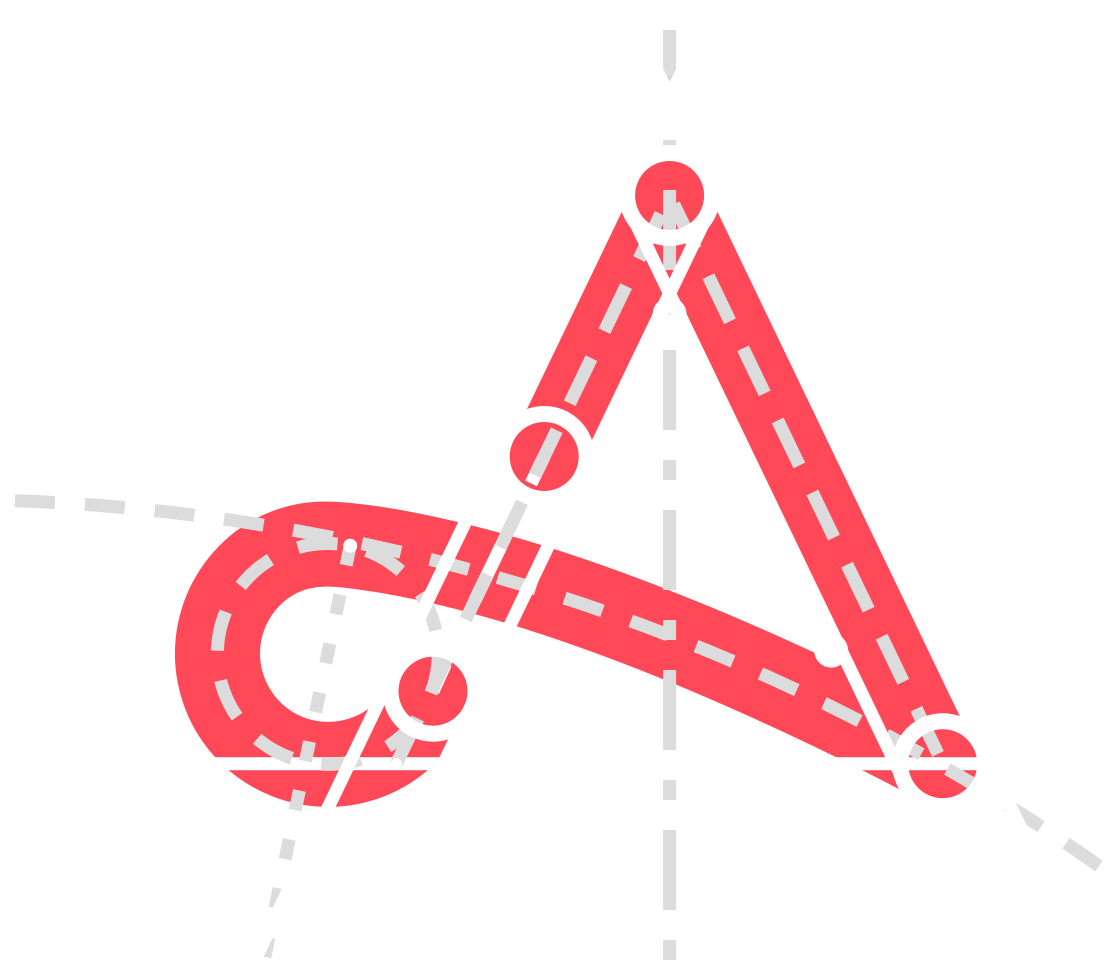
Even our logo follows measured rules: one stroke width, mirrored angles, tangent arcs. We choose technology with the same care.
Performance, security, accessibility and SEO are part of every sprint - not a checklist before launch.
01
Server rendering, optimised images and lean bundles keep LCP, INP and CLS in the green - measured on every release.
02
OWASP Top 10 practices, dependency scanning, encrypted secrets and least-privilege access on every environment.
03
Semantic HTML, keyboard support and contrast checks aligned with WCAG 2.2 AA and the European Accessibility Act.
04
Clean URLs, structured data, sitemaps and crawlable HTML, so search engines and AI assistants understand every page.
React has the largest ecosystem of any front-end library, with mature tools for almost every interface problem. Next.js adds server rendering, routing and caching on top, which gives fast first loads and pages that search engines can read without running JavaScript.
All three, depending on the job. .NET and ASP.NET Core suit long-lived enterprise systems and teams already on Microsoft technology. Node.js fits real-time features and full-stack TypeScript teams. Modern PHP is a strong choice for content platforms and existing PHP systems. We recommend one in the scope document and explain why.
Yes. Most projects start from existing code. We audit what you have, keep what works and modernise the rest step by step, so the product keeps running while it improves.
Yes, when it is built properly. Pages are rendered on the server, so search engines get complete HTML, and we add clean URLs, structured data, sitemaps and Core Web Vitals monitoring as standard.
Our default cloud is Microsoft Azure, with data centres across Europe and first-class support for .NET. Everything we ship runs in Docker containers, orchestrated with Kubernetes where the scale justifies it, so your application stays portable between providers.
If your team and back end are already on .NET, Blazor lets you build the whole product in C# and share models and validation end to end. If you need the largest ecosystem, a rich public-facing interface or strong SEO, React with Next.js is usually the better fit.
Tell us about your project and we'll get back to you within one business day.